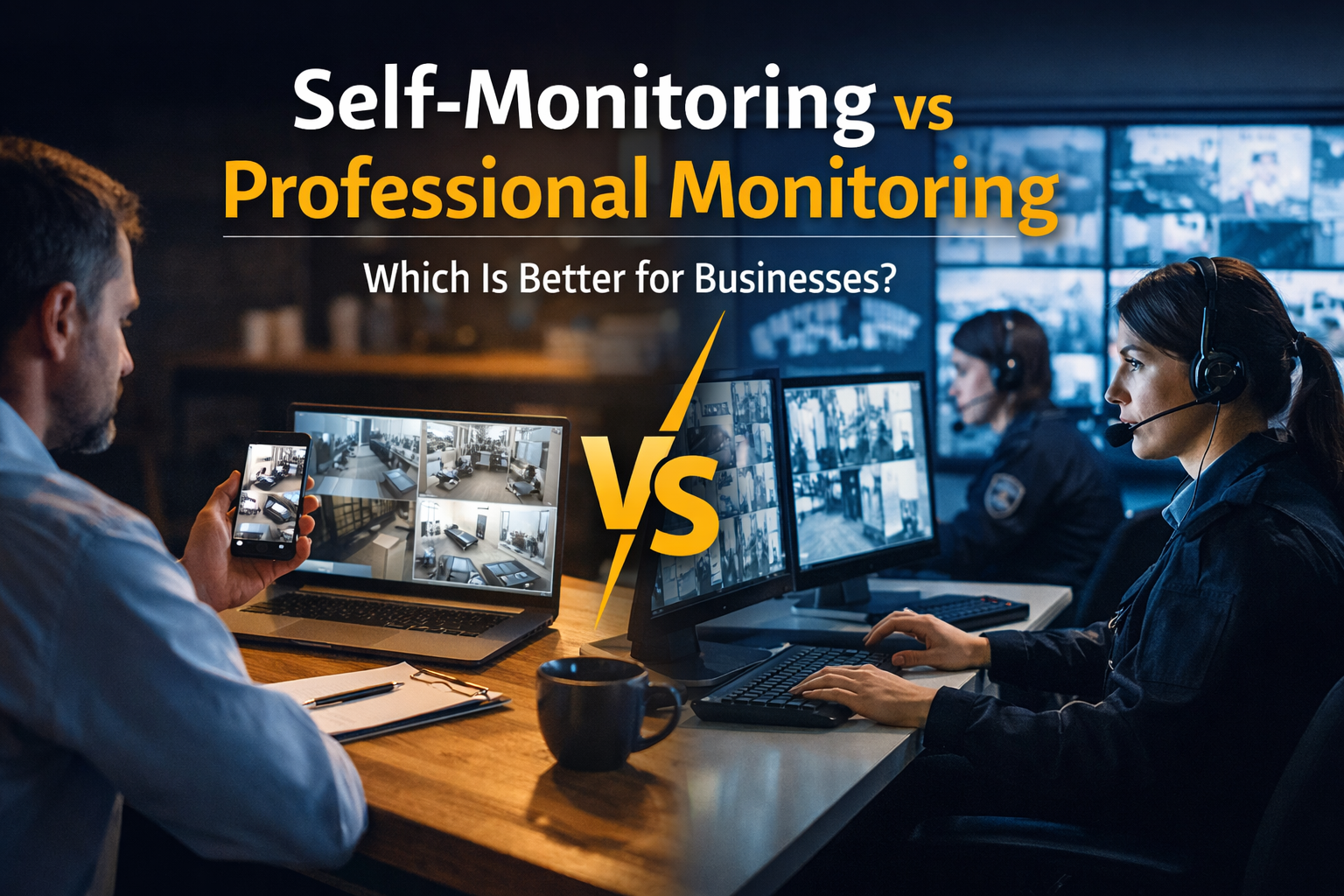
Business security has changed dramatically in recent years. With the growth of smart cameras, mobile alerts, and cloud-based systems, companies now have two main options: self-monitoring or professional monitoring. Choosing the right approach directly affects response time, loss prevention, liability exposure, and overall operational safety.
When evaluating self-monitoring vs professional monitoring, business owners must consider reliability, staffing, risk level, and whether their organization can respond to incidents 24/7. Many organizations begin with self-monitoring but later upgrade to 24/7 security monitoring or remote video monitoring services once they recognize the operational gaps.
This guide explains the key differences, when each option works best, and how businesses can choose the most effective business security monitoring solution.
The Problem
Security incidents rarely happen during convenient hours. Break-ins, vandalism, and unauthorized access often occur overnight, on weekends, or during holidays when management teams are unavailable. Businesses relying solely on internal staff to watch alerts frequently face challenges such as:
- Missed alarm notifications
- Slow response times
- Lack of overnight monitoring staff
- Inconsistent review of camera footage
- No direct connection to emergency responders
According to crime-prevention data from the National Institute of Justice
(https://nij.ojp.gov), rapid response and continuous monitoring significantly reduce property crime losses. When alerts are ignored or delayed, financial damage increases quickly.
Causes
Many companies initially choose self-monitoring because it appears more affordable and easy to manage. However, several factors often lead to security gaps:
Limited availability
Business owners and employees cannot monitor cameras around the clock. Nights, vacations, and busy operational periods create monitoring blind spots.
Alert fatigue
Frequent notifications—motion alerts, system updates, or false alarms—can cause staff to ignore or delay responses.
Lack of trained monitoring personnel
Professional monitoring centers use trained operators who verify threats, contact authorities, and follow escalation protocols. Internal staff rarely receive that level of training.
Delayed emergency coordination
When incidents occur, employees must verify alerts, contact security teams, and then call emergency services. This multi-step process increases response time compared to centralized monitoring centers.
These issues are common in retail stores, warehouses, offices, and multi-location businesses, where consistent security coverage is difficult without dedicated monitoring services.
How Professional Monitoring Helps
Professional monitoring provides continuous surveillance by trained specialists who watch alarm signals and camera alerts 24/7. Instead of relying on employees to react, a centralized monitoring center verifies events immediately and initiates the proper response.
Key ways professional monitoring improves security:
Real-time alert verification
Monitoring operators analyze incoming alerts and confirm whether an incident is legitimate before escalating it, reducing false-alarm penalties and unnecessary disruptions.
Immediate emergency dispatch
When threats are verified, monitoring centers contact law enforcement, fire departments, or emergency responders without delay. The Federal Emergency Management Agency (https://www.fema.gov) highlights that faster emergency response significantly improves property protection and safety outcomes.
Continuous overnight protection
Professional monitoring ensures protection during weekends, holidays, and non-business hours when most incidents occur.
Remote video monitoring integration
Advanced systems allow operators to view live video feeds, communicate through speaker systems, or activate deterrents such as alarms and lights.
Multi-location coverage
Businesses with multiple sites can centralize security management, ensuring uniform protection across all facilities.
Benefits
While self-monitoring offers flexibility, professional monitoring delivers broader operational advantages that are especially valuable for commercial environments.
Faster incident response
Monitoring centers react within seconds, reducing the time between detection and response.
Reduced theft and vandalism losses
Continuous oversight acts as a deterrent and allows immediate action when suspicious activity occurs.
Lower liability risk
Verified monitoring records and incident logs support insurance claims and compliance requirements.
Employee safety
Workplaces with overnight shifts or isolated locations benefit from instant emergency support if incidents occur.
Operational efficiency
Business owners no longer need to constantly watch camera feeds or manage alert notifications.
Scalable security
Monitoring solutions can expand as businesses grow, covering new facilities, departments, or operational zones.
In many industries—including logistics, manufacturing, retail, and healthcare—professional monitoring is considered a core risk-management tool rather than an optional upgrade.
Why Choose Us
Selecting the right monitoring provider is just as important as choosing the monitoring type. Businesses should work with experienced providers who understand commercial security requirements and offer tailored solutions.
Our monitoring solutions are designed for modern commercial environments and include:
- 24/7 professional monitoring centers
- Remote video monitoring integration
- Instant emergency dispatch coordination
- Custom alert escalation procedures
- Multi-location monitoring capabilities
- Dedicated technical support and system maintenance
- Scalable monitoring packages for growing businesses
We focus on proactive protection, rapid response, and reliable monitoring infrastructure to ensure businesses maintain uninterrupted security coverage.
FAQs
What is the difference between self-monitoring and professional monitoring?
Self-monitoring requires business owners or employees to receive alerts and respond manually. Professional monitoring uses trained operators who monitor systems continuously and contact emergency services when necessary.
Is professional monitoring worth the cost for small businesses?
Yes. Even small businesses benefit from faster response times, reduced losses, and continuous overnight protection that internal staff cannot consistently provide.
Can businesses combine self-monitoring and professional monitoring?
Many organizations use hybrid systems where owners receive alerts while monitoring centers provide backup emergency response and verification services.
Does professional monitoring reduce insurance costs?
Some insurance providers offer reduced premiums for businesses using professionally monitored alarm systems because they lower theft and damage risks.
Book Appointment
Choosing the right monitoring strategy depends on your facility size, operating hours, and risk level. Our security specialists can evaluate your current system and recommend the most effective monitoring setup tailored to your business operations. Contact us today to schedule a consultation and learn how 24/7 business security monitoring can protect your assets, employees, and long-term operations.